Agentic AI Automation: The Architecture Behind a Working System
Every company carries the same layer of work through its middle: a queue of unstructured input, a decision that needs judgement, and a write into a system of record. Agentic AI automation is the discipline of letting a model own that judgement while everything around it — trigger, tools, validation, approval and audit — stays ordinary, testable engineering. That sentence is the whole brief, and nearly every failed pilot I have been called in to rescue ignored the second half of it.
I design and build these systems for a living. That means the architecture, the agents and their prompts, the skills they load, the tools they are permitted to call, the servers holding the credentials, and the guardrails that decide when a person has to say yes. What follows is the design I use, why each layer exists, and why the cost of waiting compounds faster than the cost of building.
What this page gives you:
- The five layers of an agentic system architecture, and what belongs in each one.
- One task traced end to end, with every point where you should be logging.
- The agents, skills and tools split — the mistake that ruins most first builds.
- The four-phase engagement, and the artefact you keep from each phase.
- A failure table and a 30-day rollout order your own engineers can run.
Where the automatable work actually is
You do not need a strategic study to find candidates. Any process that reads messy input, applies written rules plus judgement, and writes a result into a system of record is a candidate today. That description covers far more of a company than most people expect.
| Department | Task | Trigger | What the model decides | Writes into |
|---|---|---|---|---|
| Support | Triage and first reply | inbound email or chat | intent, urgency, which playbook | helpdesk |
| Finance | Invoice capture and matching | PDF lands in a mailbox | vendor, PO match, exception reason | ERP |
| Sales | Lead qualification | form or inbound call | fit, routing, what to ask next | CRM |
| Operations | Supplier chase | delivery window missed | who to chase, how hard, when | ERP and email |
| Engineering | Incident first pass | alert fires | which runbook, what to gather | pager and ticket |
| Legal | Contract review | document upload | clause risk, which policy applies | document store |
| Data | Pipeline repair | job fails | which assumption broke | warehouse |
Not one of those columns says "chatbot". Each row is a task with a beginning, a decision and a durable effect, which is exactly what makes it auditable and worth automating.
Score the candidates on three axes before anyone builds anything: how often the task fires, how much of it is written rules rather than judgement, and what the worst wrong answer costs you. High volume plus high rule density plus a cheap wrong answer is where agentic AI automation pays back fastest. High volume with an expensive wrong answer is where you go second, behind an approval gate.
If you cannot name the trigger, the system of record and the blast radius, you do not have a task yet — you have a wish. Those three questions take one afternoon with the people who do the work, and they cut the candidate list in half.
The five layers of an agentic system architecture
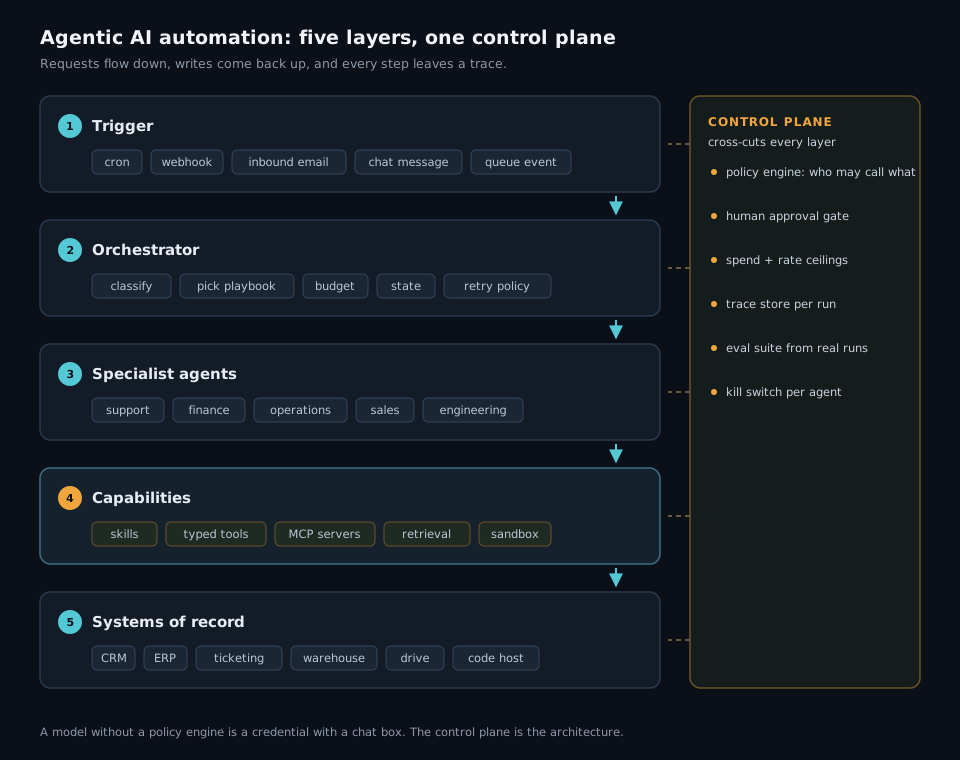
Each layer has one job, and the boundaries are what keep an agentic AI automation system debuggable when it misbehaves at 2 a.m.
- Trigger. Cron, webhook, inbound email, chat message, queue event. Nothing enters without a named trigger, because the trigger is what makes a run reproducible.
- Orchestrator. Classifies input, picks a playbook, sets a call budget, holds run state, decides when to retry or stop. This is deterministic code, not a model.
- Specialist agents. One agent per domain, narrow remit, short prompt. A support agent that also reconciles invoices is an agent nobody can evaluate.
- Capabilities. Skills carry procedure and examples, loaded only when relevant. Tools are typed functions with JSON schemas, usually behind MCP servers so credentials never enter the model's context.
- Systems of record. CRM, ERP, helpdesk, warehouse, document store. Exactly one write path per object, always through a tool that takes an idempotency key.
The orchestrator being code rather than a model is not a purist detail. A model that decides its own control flow cannot be given a budget, and a system without a budget cannot run unattended. Keeping the branching in code means the expensive part, the reasoning, gets a fixed and auditable number of chances to happen.
The right-hand column is what people skip, and it is what determines whether you get to keep the system after the pilot.
A model without a policy engine is a credential with a chat box; the control plane is the architecture. Policy decides who may call which tool, the approval gate decides which writes wait for a person, the trace store makes a wrong answer explainable a week later, and the eval suite is grown from the runs your users flagged.
How one task moves through the run

Between the two steps the model owns, the flow is deliberately boring. Walk it once:
- Trigger arrives. The payload is normalised into a struct before anything else happens.
- Orchestrator classifies. Intent, entity, playbook, call budget. A known intent maps to a fixed step list; an unknown one takes a fallback path that ends at a human.
- Agent plans. It chooses which tools to call and with which arguments. This is the only place the model is genuinely driving, and the reason agentic AI automation is worth the architecture around it.
- Validator checks. JSON Schema on every tool result, arithmetic on every total, policy on every permission, hard reject when the idempotency key is absent.
- Commit. One write path into the system of record, key recorded, so a retry cannot charge anyone twice.
- Trace and eval. Inputs, tool calls, arguments, cost and outcome, written to a store you can query by run id.
Two attempts and then a human queue: a retry budget is not a performance setting, it is the difference between a run that costs four cents and one that costs forty dollars. A rejected run returns to the agent with the validator's complaint attached, never straight back to the user, because the second attempt usually succeeds.
Agents, skills and tools are three different things
This is the split most first builds collapse, and collapsing it is why the second agentic AI automation project in a company takes twice as long as the first.
| Artefact | What it actually is | Changes how often | Proven by |
|---|---|---|---|
| Agent | a model, a system prompt, a tool allow-list, a budget | rarely | per-domain regression evals |
| Skill | a procedure with examples, loaded on demand | weekly | golden tasks |
| Tool | a typed function with a schema, scopes, idempotency | when the API changes | contract tests |
| Playbook | the deterministic step list the orchestrator follows | with the process | integration tests |
An agent decides whether to act. A skill encodes how this company does that thing. A tool is the only artefact allowed to touch the world. Keep those verbs apart and each one has a natural reviewer: the tool an engineer, the skill the team lead, the agent whoever owns the outcome.
{
 "name": "refund.create",
 "description": "Issue a refund against an existing charge. Idempotent on idempotency_key; never call twice for the same key.",
 "input_schema": {
  "type": "object",
  "required": ["charge_id", "amount_cents", "reason", "idempotency_key"],
  "properties": {
   "charge_id":       { "type": "string", "pattern": "^ch_[A-Za-z0-9]{24}$" },
   "amount_cents":    { "type": "integer", "minimum": 1, "maximum": 50000 },
   "reason":          { "type": "string", "enum": ["duplicate", "fraud", "request"] },
   "idempotency_key": { "type": "string" }
  }
 }
}
Read that as a contract, not documentation. The maximum is the blast-radius limit, the pattern rejects a hallucinated identifier, and the enum removes an entire class of creative writing. Every guardrail you can express in the schema is a guardrail you never have to argue about with a prompt.
What an engagement actually looks like
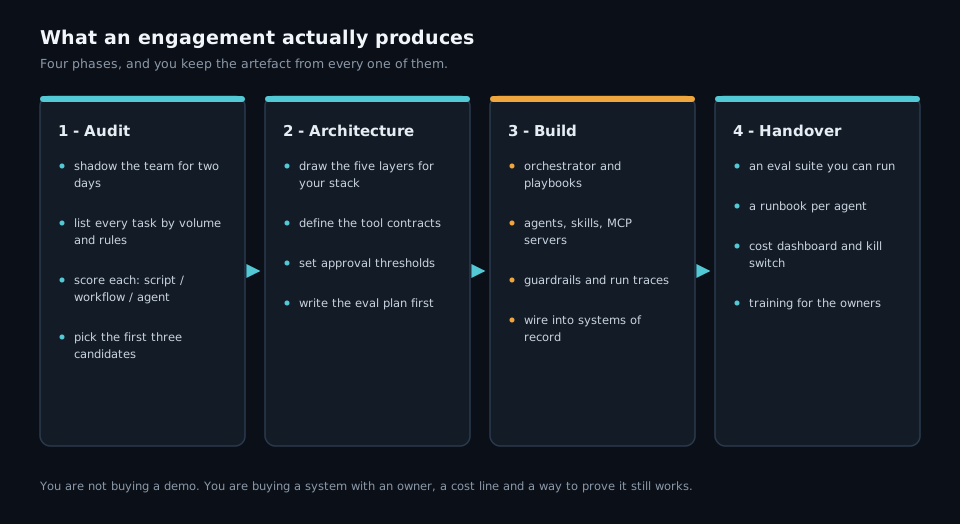
The audit phase is two days of shadowing, not a survey. I sit with the team, list every task by volume and by how much of it is written rules, then score each one as script, workflow or agent. Script wins whenever the rules are complete, because it is cheaper to run and cheaper to trust. If that sounds like I talk myself out of work, I do: the three tasks that survive the scoring are the ones that pay for the engagement, and most agentic AI automation budgets are spent on the second-best task because nobody did the scoring.
Architecture is where the five layers get drawn against your actual stack, and where the tool contracts get written before any prompt exists. Writing the eval plan at this stage, not after, is the single highest-leverage decision in an agentic AI automation project — it forces you to say what correct looks like while you are still objective about it.
Build is the part people picture: orchestrator, playbooks, agents, skills, MCP servers, guardrails, traces, wiring into systems of record. Handover is the part that keeps it alive — an eval suite you can run yourself, a runbook per agent, a cost dashboard, a kill switch and training for the people who now own the outcome.
You are not buying a demo. You are buying a system with a named owner, a cost line and a way to prove it still works after I leave. If a consultant will not put the eval suite in your hands, the system is a dependency, not a delivery.
The narrower version of this argument — how to choose between a workflow and an agent for the first task — is in Agentic Workflows: Where AI Automation Actually Pays.
Why waiting costs more than building

I am not going to quote a productivity percentage at you, because the honest ones are measured on tasks that were picked to be measurable. The structural argument is stronger and it does not need a chart with numbers on it.
The durable asset you build is not the agent. Models are rented, and the next one will be better and cheaper without any work from you. The asset is everything around the model: your processes written down as playbooks, your internal APIs wrapped as typed tools, your policies expressed as code, and a trace store full of real runs that can become regression tests.
That asset compounds in one direction only. Every flagged run becomes a test, every test makes the next agent safer to add, and every agent added makes the next tool worth wrapping. A company that starts a year later does not buy a year of model progress — it starts a year behind on the part that takes the year.
There is also a cheaper, more annoying version of the same problem. Once a vendor ships agents into a product you already pay for, you will adopt their interface, their permission model and their idea of an approval step. Defining your own tool contracts first is what lets you swap the vendor later without rewriting the process.
The companies that win this are not the ones with the best model; they are the ones whose tools are already typed, whose runs are already traced and whose evals already exist when the better model arrives. Agentic AI automation is, in the end, the only technology programme where your competitor's advantage is a directory of well-described functions and a folder of test cases.
What breaks in production
Every system in this shape fails in the same handful of ways. None of the fixes is a better prompt.
The one that catches people first is the retried write. The tool call succeeds, the HTTP response times out, the orchestrator retries because a retry is the correct behaviour for a timeout, and now the customer has two refunds. Nothing in the trace looks wrong — every individual step passed. The fix is not a warning in the prompt; it is an idempotency key generated before the first attempt and passed through every retry, so the second call is a no-op the payment provider recognises.
| Failure | How it shows up | Architectural fix |
|---|---|---|
| Double write | a customer refunded twice for one ticket | idempotency key on every write tool, one write path |
| Silent drift | output still reads fine, the totals are wrong | arithmetic validation plus a golden eval set |
| Context rot | the agent forgets the policy by step twelve | skills loaded on demand, state held outside the model |
| Permission creep | the agent is admin everywhere "to unblock it" | per-tool scopes, policy engine, no shared service account |
| Unbounded loop | forty tool calls and a bill nobody expected | call budget enforced by the orchestrator, not the prompt |
| Unowned automation | it stopped running and nobody noticed | trace store, runbook, one named owner per agent |
Notice that five of the six are fixed in code the model never sees. That is the pattern: the model supplies judgement, the architecture supplies the guarantees, and trying to get guarantees out of a prompt is how teams end up with a system that works in the demo and quietly corrupts a ledger in month three.
When someone proposes a fix that starts with "tell the model to always", the fix is in the wrong layer. Move it into a schema, a validator, a scope or a playbook and it becomes something you can test, review and hand over to whoever inherits the system. That is the entire difference between agentic AI automation that survives an audit and a demo that impressed a steering committee.
The first 30 days, in order
- Week one: audit. Shadow the teams, list tasks by volume and rule density, score script versus workflow versus agent, pick three candidates. Deliverable: a ranked list with triggers, systems of record and blast radii.
- Week two: architecture and contracts. Draw the five layers against your stack, write the tool schemas, set the approval thresholds, write the eval plan. Deliverable: a diagram your engineers can argue with and a test list.
- Week three: build one playbook, in shadow mode. Full pipeline, full tracing, zero writes. Deliverable: a week of real runs you can score against the eval plan.
- Week four: enable writes for the lowest blast radius only. Approval gate on, spend ceiling on, kill switch tested. Deliverable: one process genuinely off someone's desk, with a number attached to it.
Everything after that is repetition: widen the permissions on the first playbook, then add the second. What you must not do is start with the task that has the largest blast radius because it has the largest saving. A refund that goes wrong is recoverable; a payroll run that goes wrong is a news story.
What to do next
The gap between companies right now is not access to models. Everyone has the same endpoints. The gap is whether your internal systems expose typed operations, whether your processes are written down precisely enough to become playbooks, and whether anyone owns the trace data when a run goes wrong. Agentic AI automation is the work of building those three things, and the model is the easy part you rent.
If you want a second opinion on where to start, look at the rest of the notes on this site or send me the three tasks you would automate first through the contact form. Bring the trigger, the system of record and the blast radius for each, and the conversation gets specific fast.
Which of your tasks would fail the three questions — and is that task, or is that your process?
Need an Android Developer or a full-stack website developer?
I specialize in Kotlin, Jetpack Compose, and Material Design 3. For websites, I use modern web technologies to create responsive and user-friendly experiences. Check out my portfolio or get in touch to discuss your project.


Comments (0)
All comments are reviewed before they are published.
Be the first to comment!